Why Sri Lanka Must Move Beyond 2G: A Practical IoT Perspective for Long-Term Digitalization
Sri Lanka is at a critical point in its digital transformation journey. Across industries, from manufacturing and logistics to agriculture and energy, companies are beginning to invest in IoT (Internet of Things) solutions. However, a costly mistake is quietly repeating itself: many organizations are still deploying 2G-based systems for new implementations, unaware that this technology is approaching end-of-life. 2G is a short-term compromise that can turn into a long-term loss.
The Reality: 2G is Reaching End-of-Life
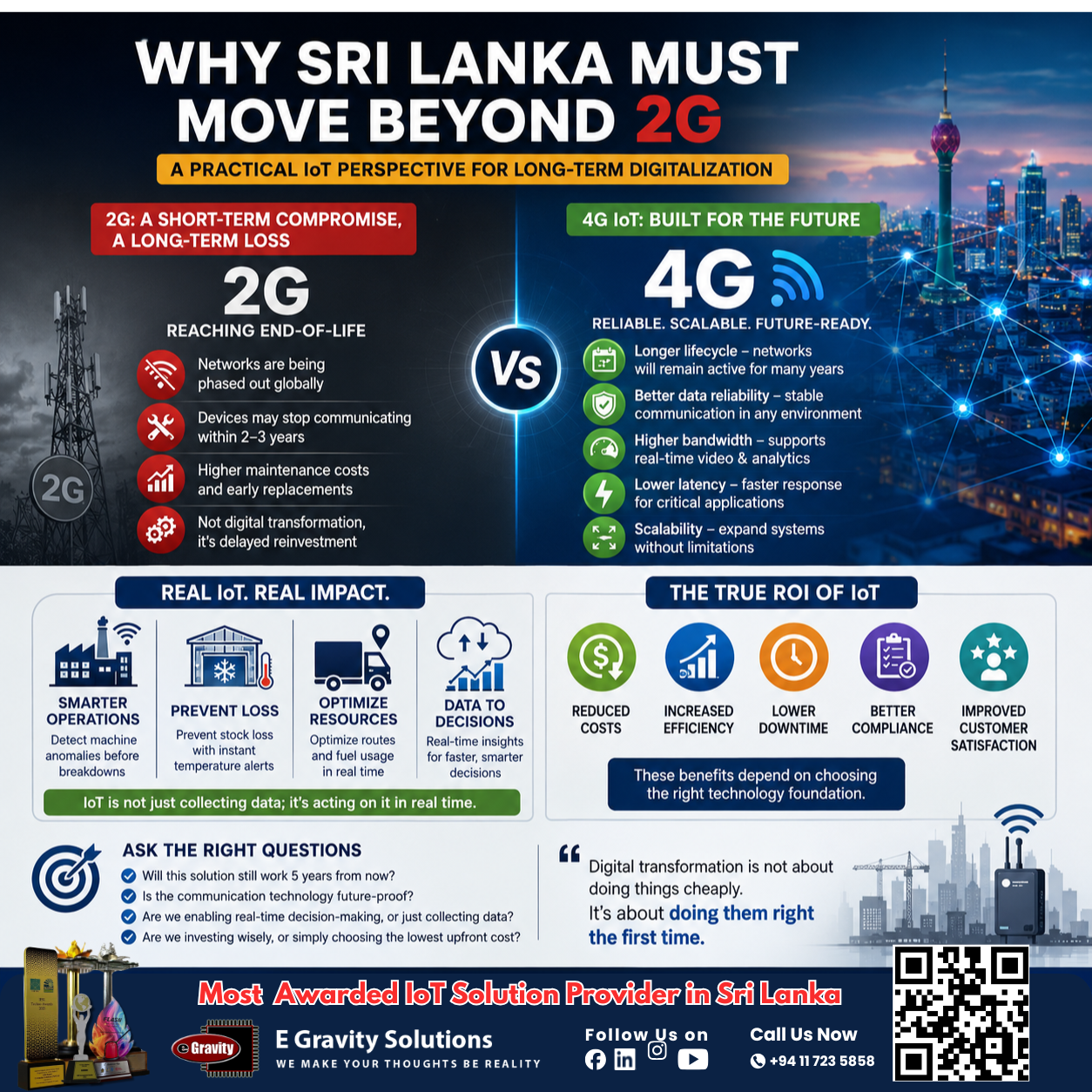
Globally, telecom operators are phasing out 2G networks to reallocate spectrum for faster and more efficient technologies like 4G and 5G. Sri Lanka is no exception. While 2G may still function today, its future is limited. Systems deployed now could become obsolete within 2–3 years.
For businesses investing in digitalization, this creates a serious risk:
Devices may stop communicating
Maintenance costs will increase
Full system replacements may be required sooner than expected
This is not digital transformation, it’s delayed reinvestment.
The Misconception: 2G is Cheaper
Traditionally, 2G modules and devices were cheaper than 4G. That is no longer the case.
Today, 4G IoT devices are widely available at competitive and in many cases, lower prices due to global demand and mass production. The price gap has closed, and in practical deployments, 4G often delivers better value for money.
So the real question is: Why invest in outdated technology when better, future-ready options cost the same or less?
4G IoT: Built for the Future
Choosing 4G is not just about speed. It’s about capability, reliability, and long-term sustainability.
Key advantages include:
Longer lifecycle – 4G networks will remain active for many years
Better data reliability – Stable communication, even in high-demand environments
Higher bandwidth – Supports real-time monitoring, video, and advanced analytics
Lower latency – Faster response times for critical applications
Scalability – Easily expand systems without infrastructure limitations
For industries planning serious digital transformation, these are not luxuries, they are necessities.
The Bigger Issue: How IoT is Being Used Locally
Another challenge in Sri Lanka is not just what technology is used, but how it is used.
Many companies still rely on:
Display panels showing real-time values without data storage
Data loggers that only provide information after an incident occurs
Manual monitoring and reporting systems
Low-cost, outdated solutions that don’t integrate with modern platforms
This approach limits the true power of IoT. IoT is not just about collecting data; it’s about acting on data in real time.
Moving Beyond Basic Monitoring
Modern IoT systems powered by 4G enable:
Real-time alerts before failures occur
Predictive maintenance to reduce downtime
Remote access and control from anywhere
Cloud integration for analytics and reporting
Automation that reduces human error and operational cost
For example:
A factory can detect machine anomalies before breakdowns
A cold storage facility can prevent stock loss with instant temperature alerts
A fleet operator can optimize routes and fuel usage in real time
These are not future concepts; they are available today.
The True ROI of IoT in Sri Lanka
When implemented correctly, IoT is not an expense; it is an investment that delivers measurable returns:
Reduced operational costs
Increased efficiency
Lower downtime
Better compliance and reporting
Improved customer satisfaction
But these benefits depend on choosing the right technology foundation.
A Call to Action for Sri Lankan Businesses
If your organization is planning a new IoT or digitalization project, ask these critical questions:
Will this solution still work 5 years from now?
Is the communication technology future-proof?
Are we enabling real-time decision-making, or just collecting data?
Are we investing wisely, or simply choosing the lowest upfront cost?
Digital transformation is not about doing things cheaply. It’s about doing them right the first time.
Conclusion
4G IoT technology is now accessible, affordable, and essential for sustainable digital growth. Continuing to deploy 2G systems today is like building new infrastructure on outdated foundations.
For businesses serious about long-term success, the message is clear:
Don’t digitize with yesterday’s technology.
Choose 4G. Build smarter. Stay future-ready.